Progress of major emitters towards climate targets
This report by NewClimate Institute, PBL Netherlands Environmental Assessment Agency, and the International Institute for Applied Systems Analysis (IIASA), provides an overview of projected greenhouse…
The ELEVATE Annual Net-Zero Reports aim to provide policymakers with a clear, evidence-based understanding of where global efforts currently stand regarding achieving these goals, and how national and…
A UN Environment Programme (UNEP) assessment of available new climate pledges under the Paris Agreement finds that the predicted global temperature rise over the course of this century has only…
Implications of global distributive justice principles for implementation of the Kunming-Montreal Global Biodiversity Framework
In the era of the sixth mass extinction, reversing global biodiversity loss is of vital importance for life on Earth. In 2022, parties to the Convention on Biological Diversity (CBD) adopted the…
Inaugural lecture delivered by Michel den Elzen upon accepting the position of special professor of International Climate Policy and Mitigation of Climate Change, on behalf of the Netherlands…
Impact factors for quantifying country-level terrestrial biodiversity intactness footprints (IBIF)
There is an increasing demand for consistent methods and tools to quantify biodiversity footprints: the magnitude of biodiversity loss associated with all direct and indirect impacts associated with a…
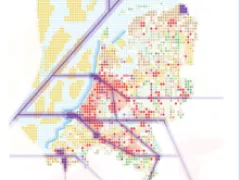
Maps are powerful tools to communicate and discuss the content of spatial scenarios with policymakers, planners and the public. Scenario projects become more accessible when visually presented by maps…
Climate and Energy Outlook of the Netherlands 2025
The greenhouse gas emissions of the Netherlands are projected to reduce by 45-53% in 2030 compared to 1990, in the baseline projection. As such, the probability of reaching the target of 55% reduction…
Opportunity cost estimates for spatial conservation prioritisation across terrestrial Europe
Opportunity costs of conservation represent the foregone economic benefits from using land for nature conservation rather than alternative activities. Considering opportunity costs therefore helps in…
A century of land consolidation in the Kingdom of the Netherlands: trends, drivers and lessons for future challenges
In the Netherlands and elsewhere an upsurge in the attention for rural land development can be observed. Land development is considered a key instrument in the toolbox to address the challenges rural…
 PBL Netherlands Environmental Assessment Agency