Enhancing regional resilience for energy price shocks: efficient gas use and upstream decarbonization
Resilience and competitiveness in relation to fossil energy dependencies is of increasing concern to industries and policy makers. We investigate to what extent the competitive position of industries…
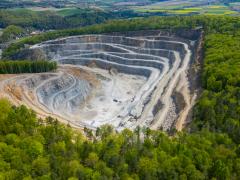
The many pathways of mining impacts on biodiversity
Mining is a significant driver of biodiversity loss, with impacts expected to escalate due to rising metal demand for the energy transition. However, global assessments of mining impacts are still in…
Staying on track: a bottom-up Paris-aligned pathway driven by COP initiatives
Voluntary climate initiatives have the potential to increase emission reductions and guide deeper, sustained reductions under the UNFCCC, but significant gaps remain in thematic coverage, ambition…
Quantifying the Costs and Benefits of Grid Investments to Decarbonize the European Energy Supply
Europe aims to achieve climate neutrality by 2050 through the electrification of fossil fuel-based energy demand and the large-scale deployment of renewable generation. Realizing these goals requires…
Mercantilist and protectionist shocks on innovation, growth, and economic policy in European regions
We assess the potential innovation and growth implications on European regions of the rapid global shifts in political economy towards mercantilism, tariffs, and protectionism. The new trade shocks…
Vooral industriële regio’s in Europa kwetsbaar voor Amerikaanse heffingen
De hoge muren van importheffingen die het afgelopen halfjaar door de Verenigde Staten zijn geïntroduceerd, hebben negatieve consequenties voor de economische activiteit. Voor welke Europese en…
Elektrische auto’s leveren aanzienlijke voordelen op voor klimaat en luchtkwaliteit, maar zorgen tegelijkertijd voor een toename van het autogebruik. Vooral tijdens het weekend en bij stedelingen…
Implications of global distributive justice principles for implementation of the Kunming-Montreal Global Biodiversity Framework
In the era of the sixth mass extinction, reversing global biodiversity loss is of vital importance for life on Earth. In 2022, parties to the Convention on Biological Diversity (CBD) adopted the…
Impact factors for quantifying country-level terrestrial biodiversity intactness footprints (IBIF)
There is an increasing demand for consistent methods and tools to quantify biodiversity footprints: the magnitude of biodiversity loss associated with all direct and indirect impacts associated with a…
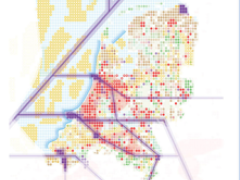
Maps are powerful tools to communicate and discuss the content of spatial scenarios with policymakers, planners and the public. Scenario projects become more accessible when visually presented by maps…
 Planbureau voor de Leefomgeving