Inaugural lecture delivered by Michel den Elzen upon accepting the position of special professor of International Climate Policy and Mitigation of Climate Change, on behalf of the Netherlands…
Impact factors for quantifying country-level terrestrial biodiversity intactness footprints (IBIF)
There is an increasing demand for consistent methods and tools to quantify biodiversity footprints: the magnitude of biodiversity loss associated with all direct and indirect impacts associated with a…
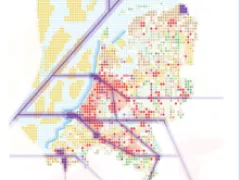
Maps are powerful tools to communicate and discuss the content of spatial scenarios with policymakers, planners and the public. Scenario projects become more accessible when visually presented by maps…
Climate and Energy Outlook of the Netherlands 2025
The greenhouse gas emissions of the Netherlands are projected to reduce by 45-53% in 2030 compared to 1990, in the baseline projection. As such, the probability of reaching the target of 55% reduction…
Opportunity cost estimates for spatial conservation prioritisation across terrestrial Europe
Opportunity costs of conservation represent the foregone economic benefits from using land for nature conservation rather than alternative activities. Considering opportunity costs therefore helps in…
A century of land consolidation in the Kingdom of the Netherlands: trends, drivers and lessons for future challenges
In the Netherlands and elsewhere an upsurge in the attention for rural land development can be observed. Land development is considered a key instrument in the toolbox to address the challenges rural…
Update report: Decarbonisation options for salt and chlor-alkali production by Nobian Industrial Chemicals B.V.
The Dutch government aims to make tailor-made agreements with the most energy-intensive plants in the Netherlands to support their decarbonisation. In December 2024, salt and chlor-alkali producer…
As part of the Paris Agreement, countries worldwide committed to limiting global warming to well-below 2°C and to pursuing effort to limit the increase to 1.5°C above pre-industrial levels. While high…
Land remains a blind spot in tracking progress under the Paris Agreement due to lack of data comparability
Land carbon fluxes are key to the Paris Agreement. However, data comparability issues persist between countries’ land greenhouse gas inventories and mitigation targets, and what land models…
Linking a biodiversity abundance metric to life cycle assessment for quantifying the biodiversity footprint of Dutch diets
The global food system is a major driver of biodiversity loss through land occupation, greenhouse gas emissions, nutrient emissions, pollution, and other environmental pressures. There is a need to…
 PBL Netherlands Environmental Assessment Agency